
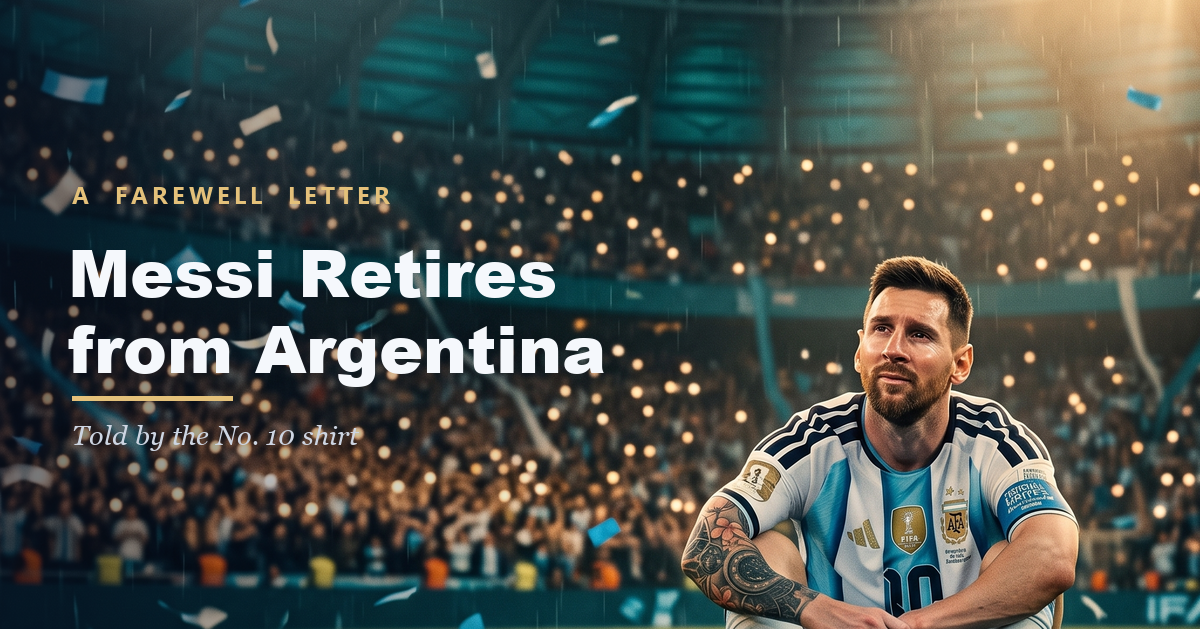
Messi Retires From Argentina: A Farewell Told by the No. 10 Shirt
On August 31, 2026, Lionel Messi posted a letter to Instagram and ended the longest love story in international football. He is 39. He has given Argentina 21 years, 207 matches and three trophies that mattered, and now he is done — and every outlet on earth is running the same obituary tonight: the numbers, the honors, the tears in Qatar.
Fine. But I was there for all of it — hung in the locker, printed with a 1 and a 0 — and I think somebody owes you the version from my side of the seam.
You've met me before. I'm the albiceleste No. 10: sky-blue and white stripes, three stars over the crest, sun in the middle. I have been soaked in champagne in Qatar and Rio, folded into a duffel bag in New Jersey, and worn by the only man who ever made a number feel small. This is my farewell letter. His got published. Mine had to wait for a jersey shop to write it down.
The Letter He Sat On for 40 Days
Here is the detail the highlight reels will skip: that goodbye was not written on August 31. It was written on July 21 — two days after the World Cup final in New Jersey, where Argentina lost 0-1 to Spain. Then he folded it up and carried it in silence. On August 8, his father Jorge died. On August 31, he hit publish.
So the farewell the world watched was drafted, edited and privately held for forty days while its author buried his father. The press is calling the timing dignified. Maybe. But call it what it also is: a man rationing his own grief. Football demanded a statement, and he gave it a eulogy — written before the funeral, held through a real one, released only when the two had fused into something he could finally carry in public.
And notice how it arrived. No press conference. No farewell friendly with confederation flags and a guard of honor. Not even a federation statement first — the Argentine Football Association learned about the biggest story in its history roughly the same moment you did, by opening an app. A league of one, posting his own ending, refusing to let anyone else hold the pen. After 21 years of having his words translated, managed and massaged, he made his exit the one way it couldn't be edited: alone, on his own channel, in his own words.
207 Caps, and He Counted Every One
Now the ledger, because the ledger is the story:
- 207 international appearances — the most in Argentina's history
- 125 goals — the most in Argentina's history
- 68 assists — the most in Argentina's history
At World Cups alone, he leaves holding the all-time records for matches played (34), assists (12) and goal involvements (33). And 21 World Cup goals — a total no player in the tournament's history had ever reached before him, and one that will read "second place" forever, because Kylian Mbappé finished with 22.
Think about that arithmetic. The most complete international career ever measured, and the record books will still open at the one column where he is exactly one goal short — in the last final he ever played. Football doesn't do poetry. It does balance sheets.
I Remember the Red Card
Nobody tells the beginning of this story anymore, so I will.
August 2005, Budapest. An 18-year-old comes on against Hungary for his senior debut and is sent off within minutes — a red card in his first international appearance, before most of the stadium had learned his name. He had just won the U-20 World Cup that summer. He walked off a champion and a national punchline in the same month, and the papers back home were not kind about which one they thought was real.
The arc after that, people will recite: gold at the 2008 Beijing Olympics; the 2014 final at the Maracanã, 0-1 to Germany in extra time, the cruelest 120 minutes the stripes ever carried; the 2021 Copa América, the trophy that finally unlocked him; 2022 in Qatar, the World Cup, the night the whole thing balanced; 2024, another Copa América.
I prefer the arc nobody recites: red card, gold medal, world champion. Sixty seconds after arriving, sent off. Three years later, unbeatable. Whatever Argentina decides to do with the number 10 going forward, they should remember it was introduced by a sending-off. Nothing about this man was ever clean or easy. Not even the start.
He Quit Once Before. We Counted the Days.
Now the uncomfortable part, because you deserve a farewell that doesn't sand off the edges.
He has done this before. In 2016, after losing the Copa América final on penalties — after missing his own kick — he announced his retirement from the national team. Argentina went into mourning, the country's president publicly asked him to reconsider, and roughly six weeks later he un-retired.
So when the word "retirement" appears next to Messi, Argentina has learned to hold its breath and wait. This time, don't. Compare the two statements. 2016 was a mood — a man reacting in the worst minute of his worst night, anger wearing a suit. 2026 is arithmetic — a man who has done the math on his own body, found the account empty, and closed it in good order. "I emptied myself" is not something you say in anger. It's something you say when you've checked twice.
He also wrote that from now on he will support Argentina from the stands, "in good times and in bad," and thanked God "for making me Argentine." Read that again. Not for the talent. Not for the trophies. For the passport. After everything this country asked of him — the criticism, the years-long verdict that he didn't care enough, the demand that he sing the anthem louder — the last thing he chose to publish about himself was gratitude for belonging to it.
You can find that moving. I find it a little devastating. Both are allowed.
Two Finals, Twelve Years Apart, Same Scoreline
The symmetry is the part I can't get over, and I was in the room for both.
2014, Rio de Janeiro: Argentina 0-1 Germany, in extra time, in the World Cup final. 2026, New Jersey: Argentina 0-1 Spain, in the World Cup final. Twelve years apart, the same scoreline, the same silver medal — and in between, three major trophies in four years, including the one at the very top of the mountain.
His Argentina career ends the way the hardest stretch of it began: losing a World Cup final by a single goal. The man who fixed everything — who rearranged an entire federation's expectations, who turned "Argentina can't win with him" into a trophy cabinet — could not fix the ending. Maybe there's a mercy in that. Endings you write yourself are for men who left something on the table. His ending was written by the same game that wrote his beginning, and neither chapter asked for permission.
The federation's response was two words: "Gracias, capitán." Thank you, captain. They said nothing about the number. Nobody ever does. A shirt number is a rented room; they'll simply wait for the next tenant and hand him the key with a ceremony and a speech about legacy.
I'd like to see them try.
What Happens to the Shirts Now
Here's what I know from my side of the seam: when a player like this leaves, people don't stop wearing the shirt. They start. The Messi Argentina 2026 home jersey stopped being merchandise this week and became a memory object — the last one of the 207-cap era, the shirt from the summer he finally said goodbye.
If that's you, a few notes from someone who knows the fabric: if you'd rather put your own name and number on the back instead of his — honestly, one of the better tributes going — our jersey customization guide walks through how name-and-number printing works. And if you already own one, treat it like what it now is: an artifact. Hot dryers have ended more shirts than defenders ever did — our jersey care guide covers how to wash one without wrecking the numbers.
That's the whole commercial portion of this eulogy. The rest is between him and us.
Questions Everyone Is Asking
On August 31, 2026, in a letter posted to his Instagram account. He was 39 years old. The letter was actually written on July 21, two days after the 2026 World Cup final.
207 international appearances, 125 goals and 68 assists — all three are Argentina national team records. He also holds the all-time World Cup records for matches played (34), assists (12) and goal involvements (33).
The 2026 World Cup final on July 19, 2026, in New Jersey, which Argentina lost 0-1 to Spain.
Yes — in 2022 in Qatar. He also won the Copa América in 2021 and 2024, Olympic gold at Beijing 2008, and the U-20 World Cup in 2005.
No. His announcement covers the Argentina national team only; he continues to play his club football for Inter Miami.
The Messi Argentina 2026 home jersey is available in our store, with Fan Edition and Replica styles in adult and youth sizes.
Last thing. In the letter, he says that from now on he'll be supporting Argentina from the stands, in good times and in bad. So the arrangement is this: the man moves to the seats, and the stripes stay down here with us. Somebody has to keep the 10 warm.
Gracias, Leo. It was an honor being stretched.
— The No. 10